
• At Gal Oya Plantations, sugar is only the beginning. From farmer support and local sugar production to renewable energy, ethanol, carbon dioxide, organic fertiliser and a developing farm-to-bottle model, the operation is steadily turning each part of the sugarcane crop into wider economic and environmental value.
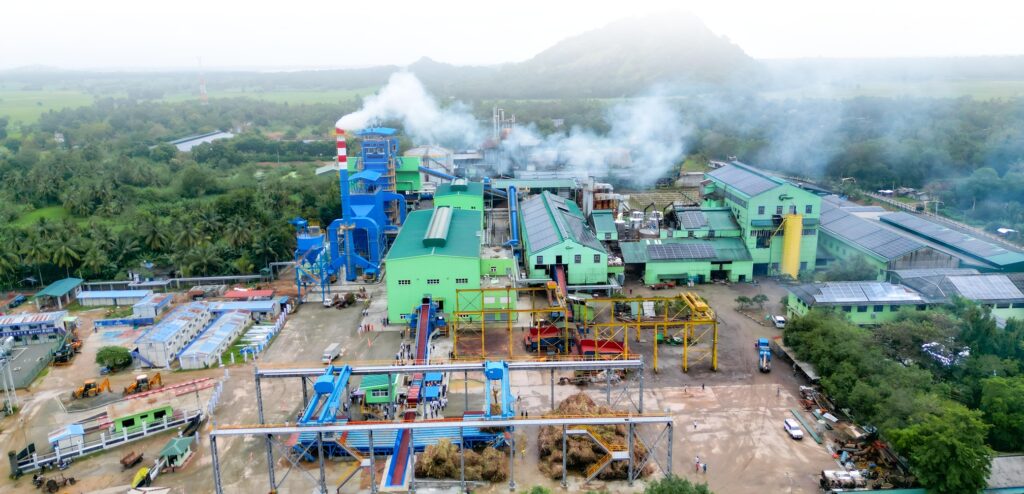
In the fields around Ampara, sugarcane begins as a rural crop. By the time it has moved through the Gal Oya Plantations complex, however, it has become far more than sugar. The cane juice is processed for the domestic market. The fibre helps generate steam and electricity. Molasses is converted into Extra Neutral Alcohol. Fermentation creates carbon dioxide and biogas. Filter mud and other organic residues are returned to the soil as compost. Water is treated for reuse. What appears at first to be a conventional sugar factory is, in practice, an interconnected value chain in which agriculture, manufacturing, energy and environmental management reinforce one another.
This integrated model is the real story of Gal Oya Plantations. Its importance is not measured only by the quantity of sugar produced, but by how much value is retained within the Eastern Province before, during and after every crushing season.
The story begins with the landscape itself. The Gal Oya Valley was one of Sri Lanka’s earliest post-independence development undertakings, created around irrigation, settlement and agricultural production. Sugarcane cultivation commenced in the Ampara area in the 1950s, followed by sugar production in 1960 and distillery operations in the early 1960s. The factory later passed through several institutional changes before closing in the late 1990s, leaving farmers without the dependable market around which the regional cane economy had been built.
Its revival under Gal Oya Plantations restored more than a factory. It re-established the connection between the field, the farmer, transporters, harvesters, technicians, factory workers and downstream industries. The operation was structured as a public-private partnership, with the Government of Sri Lanka retaining a majority stake and private-sector partners undertaking the management and redevelopment of the enterprise.
Today, the first link in the chain remains the farmer. Gal Oya Plantations supports cane growers with planting material, agricultural inputs, training, extension services and a buy-back market for the harvested crop. This relationship is crucial because sugarcane is not a crop that can be sustained by cultivation alone. Farmers need access to suitable varieties, field advice, fertiliser, harvesting arrangements and timely transport to the mill. The factory therefore functions as the commercial centre of a much broader agricultural system.
The scale of that system has expanded considerably. The Ministry of Industry and Entrepreneurship Development’s 2025 progress report recorded 11,613 farmers and 11,005 hectares under cultivation, with 348,847 metric tonnes of cane supplied for crushing between January and September 2025. The same report placed direct employment at approximately 1,250 and estimated that the wider operation supports tens of thousands of indirect livelihood opportunities. Every tonne of cane entering the factory carries value generated by growers, field workers, machinery operators, transport providers and rural service businesses.
The value chain can also be traced through the money circulating within the region. Information supplied for this feature indicates that payments to farmers have exceeded Rs. 23 billion, while a further Rs. 14 billion has gone towards harvesting, transport and cultivation-related services. Employees have received more than Rs. 9 billion in salaries and allowances since 2007. These figures show how the crop creates value well before a bag of sugar leaves the factory, supporting household incomes and a network of local enterprises.
At the mill, the cane is crushed and its juice processed into locally produced brown sugar. This is the most visible product, but it is only one branch of the value chain. Domestic sugar production also has a wider national purpose. Sri Lanka continues to meet most of its sugar requirement through imports, so every kilogram produced locally represents economic activity retained within the country and a measure of foreign exchange saved. For the communities around Digamadulla, that national objective translates into a reliable market for a crop grown close to home.
The fibrous material left after crushing, known as bagasse, creates the next stream of value. Rather than being discarded, it is used as a renewable fuel to produce steam and generate electricity for the industrial process. This reduces the factory’s dependence on conventional external energy while giving a second productive life to a material that would otherwise become waste. Gal Oya Plantations has also added solar generation to its energy mix. During the first nine months of 2025, the operation generated 26,695 MWh of power and a further 2,144 MWh from solar energy, according to the Ministry’s progress report.
The sugar-making process also produces molasses, a rich by-product that feeds directly into the distillery. At Ampara, molasses is fermented and distilled into Extra Neutral Alcohol, commonly known as ENA, a high-purity alcohol used as a base across several industries. The distillery is designed to produce 21,500 litres a day, and Gal Oya recorded more than 3.2 million litres of ENA between January and September 2025. This link significantly deepens the value of the original crop. Sugarcane grown by a farmer in Ampara is no longer tied to a single commodity market; it becomes the starting point for multiple industrial products.
The developing farm-to-bottle concept is a natural extension of this chain. Gal Oya Plantations received approval in 2025 for a liquor bottling operation, with preparatory work subsequently initiated and production planned for 2026. Once operational, the proposed facility would connect cultivation, milling, molasses production, distillation and bottling within one local ecosystem. The significance lies in moving beyond the bulk sale of ENA towards a finished, packaged product with greater value addition. It would allow more of the commercial benefit created by the cane crop to remain within the enterprise and the region, while creating new requirements in quality assurance, packaging, logistics, and distribution.
Fermentation creates further opportunities. Carbon dioxide generated during the process can be captured instead of being released unused, turning an emission stream into a marketable industrial input. The Government’s 2025 report states that Gal Oya’s carbon dioxide production project, together with its solar energy and factory expansion projects, had been completed and was in operation. The distillery also generates biogas, with 624,841 kilograms recorded during the first nine months of 2025. Used effectively, these streams help reduce waste, improve energy efficiency and broaden the factory’s product base.
The circularity continues at the compost yard. Filter mud from sugar processing and organic residues associated with the distillery can be converted into soil-enriching material instead of becoming a disposal burden. Gal Oya Plantations operates what the Ministry describes as Sri Lanka’s largest organic fertiliser yard. It produced 4,503 metric tonnes of compost between January and September 2025, while information provided for this feature indicates that more than 25,000 metric tonnes of bio-compost have been produced since 2018. Much of this material can return to cultivation, helping improve soil condition and reducing the value chain’s reliance on purely chemical inputs. The crop leaves the farm, passes through the factory and, in another form, comes back to the land.
Water management is another essential part of the system. Sugar and distillery operations require significant quantities of water, making treatment and reuse central to responsible production. Gal Oya’s water purification facility has a stated capacity of 250,000 litres per hour, while the distillery was designed with a 400-kilolitre-per-day wastewater treatment facility. Treating process water and recirculating it where possible reduces pressure on freshwater resources and supports cleaner industrial operations in a region where agriculture and communities depend heavily on the same water landscape.
Seen as a whole, the Gal Oya model is not a straight line from farm to factory. It is a loop. Farmer services strengthen cultivation. Cane sustains the sugar mill. Sugar production creates bagasse and molasses. Bagasse supports energy generation. Molasses feeds the distillery. Fermentation produces ENA, biogas and carbon dioxide. Organic residues become compost that can nourish the next crop. The planned bottling operation can carry that journey one step further, from the cane field to a finished consumer product.
This is why Gal Oya Plantations matters beyond its factory gates. It anchors a rural economy, supports local production and shows how an agricultural crop can be used with greater discipline and imagination. Its most compelling achievement is not simply that an old factory was revived, but that a wider industrial ecosystem has been rebuilt around it. In Ampara, the value of sugarcane no longer ends when the sugar is made. It continues through energy, alcohol, carbon dioxide, fertiliser, water recovery, employment and the prospect of a genuinely local farm-to-bottle story.